Most flowers are in the business of being liked. The corpse flower is in the business of being mistaken for a dead animal, and it is spectacularly good at it. A few times a decade, a plant in a Bay Area greenhouse swells, unfurls and releases a smell that people compare to a hot garbage truck, and thousands of otherwise sensible adults get in line to experience it on purpose. As florists, we are professionally committed to flowers that smell nice. We would still not miss this for anything.
🌱 What You Are Actually Looking At
The corpse flower is a plant called Amorphophallus titanum, or the titan arum, and it comes from the rainforests of Sumatra in Indonesia. Its Indonesian name, bunga bangkai, means exactly what you think it does.
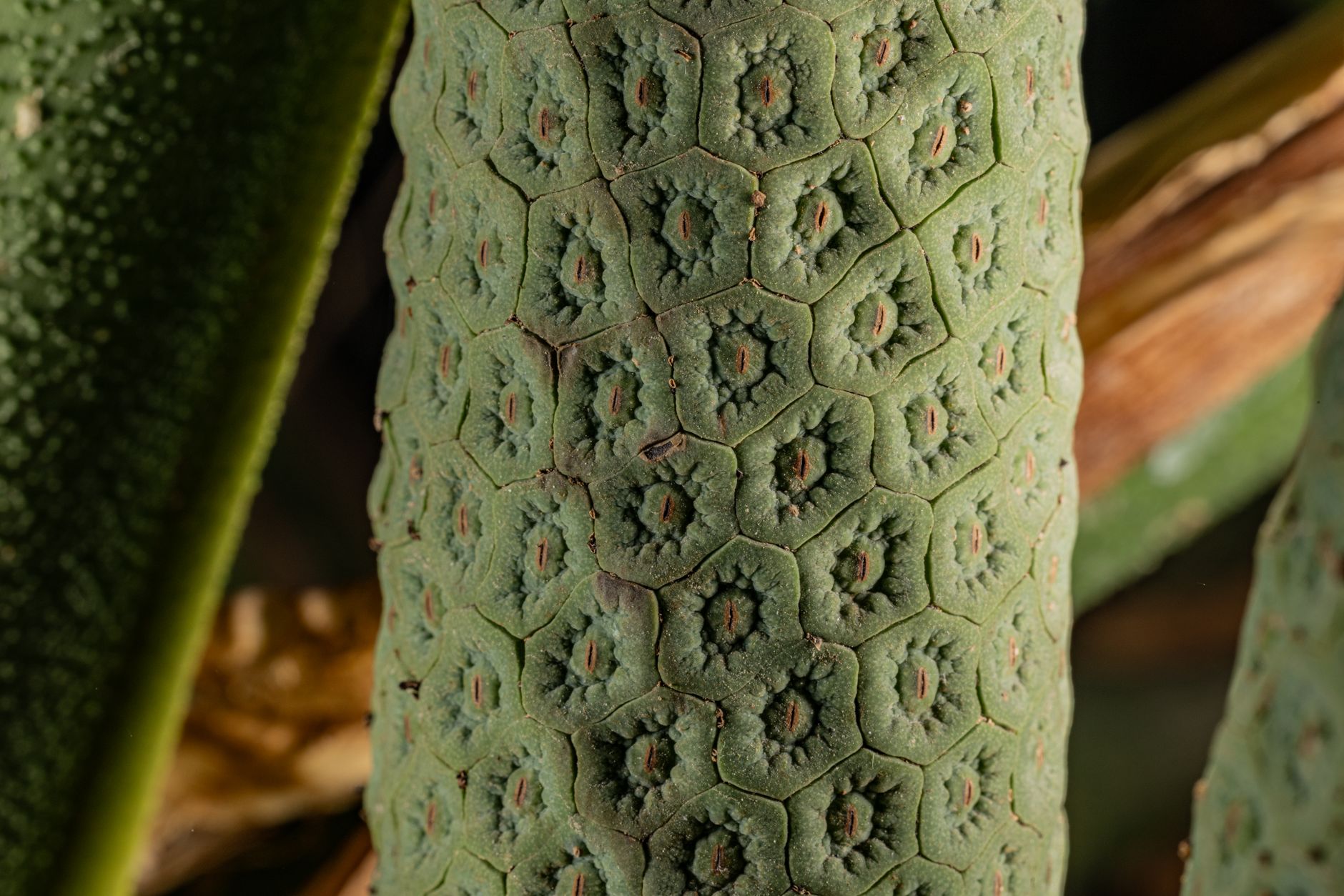
Here is the part that surprises people: it is not one flower. What looks like a single enormous bloom is an inflorescence, a tall central spike wrapped in a deep burgundy, ruffled collar, with hundreds to thousands of tiny flowers tucked inside. It can reach around ten feet tall, which makes it the largest unbranched inflorescence in the plant kingdom. (If you want the biggest single flower, that title belongs to a different Sumatran oddity, Rafflesia arnoldii, whose bloom measures about three feet across.)
The rest of the plant is just as dramatic. Between blooms it grows a single enormous leaf, up to about 15 feet tall, that is so treelike it is often mistaken for one. The leaf feeds an underground tuber that can weigh more than 200 pounds. Then, after years of this, the plant sometimes skips the leaf and sends up the flower instead.
🧪 Why Does It Smell Like That?
Because it is lying. The corpse flower’s pollinators are carrion beetles and flesh flies, insects that lay their eggs on dead animals, and the plant has evolved to smell and look like a meal. The deep red inside, the texture, and even the temperature are part of the act: at its peak, the central spike warms to nearly body temperature, which helps the scent carry. The scent can be detected from up to about half a mile away.
Botanists have analyzed what is in it, and the list reads like a horror-movie ingredient label:
- a compound that smells like Limburger cheese
- one that smells like garlic
- one that smells like rotting fish
- one that smells like sweaty socks
- one that smells like feces
- and, almost insultingly, one that smells sweetly floral
The staff at San Francisco’s Conservatory of Flowers describe a scent that changes through the night: first an onion-and-garlic funk, then something like a hot garbage truck in summer, and later something distinctly like a dead rodent. Every bloom, they say, smells a little different.
📺 The Name That Was Too Rude for Television
One of our favorite pieces of corpse flower trivia is its scientific name. The genus name, Amorphophallus, comes from Greek and means, roughly, “misshapen phallus.” The story goes that when the plant was filmed for David Attenborough’s 1995 series The Private Life of Plants, the name was considered too rude for television, and the friendlier “titan arum” was used instead. It stuck. If you have only ever heard it called titan arum, now you know why.
🌹 Scarlet at the Conservatory of Flowers, Golden Gate Park
San Francisco’s resident star is a corpse flower named Scarlet, at the Conservatory of Flowers in Golden Gate Park. Scarlet bloomed in late June 2026, and the Conservatory’s curators told reporters beforehand that the whole process is unpredictable, with staff sending each other photos of the swelling bud as the days ticked by. When a bloom is confirmed, the Conservatory extends its evening hours and releases timed tickets. Previous bloom events have drawn roughly 7,000 visitors over just a few days, and the Conservatory set aside a special “maximum stink hour” for members in the final hour of the first night.
It is the kind of event that makes San Francisco feel like San Francisco: a historic glass greenhouse, a line out the door, and a crowd delighted to be disgusted together. If you want to plan around Golden Gate Park, our Golden Gate Park flower trail covers what else is blooming.
🏫 Trudy at UC Botanical Garden, Berkeley
Across the Bay, the UC Botanical Garden in Berkeley has its own corpse flower history, and it is a good story. In July 2005, a titan arum nicknamed Trudy bloomed there, and visitors lined up outside the gates before the garden opened. Trudy was raised by a Sunnyvale plant enthusiast named Bill Weaver, who loaned it to the garden and named it for a neighbor who had helped him build one of his greenhouses. It followed a national habit of giving blooming titan arums a human name starting with “T.” The garden’s own plants came from seeds collected in Sumatra and given to the garden in 1995 by a San Franciscan named James Symon. Trudy bloomed again in 2009 and 2012, and the garden has seen several more blooms since, with nicknames like Odora and Little Stinker.
According to the garden, a blooming titan arum typically needs at least six or seven years of growth before its first bloom, stays open only a day or two, and produces its stench for just eight to twelve hours. Our guide to Berkeley’s gardens covers the rest of the neighborhood.
⏰ How to Catch the Next One
The honest answer is that nobody can tell you when. A mature plant may bloom every few years, and the exact day is anyone’s guess until the bud starts to open. What helps:
- Follow the gardens. The Conservatory of Flowers and the UC Botanical Garden both post updates when a bloom is close, and both have offered livestreams.
- Move fast. The flower is open for only a day or two. The strongest smell usually arrives on the first evening and lingers into the next morning, so evening opening hours are the prime time.
- Expect crowds. Timed tickets, extended hours and lines are normal during a bloom.
- Bring a friend. Reactions are half the entertainment.
- No luck with timing? The livestream counts, and you will not have to smell it afterward.
🚨 A Serious Note: It Is Endangered
Behind the jokes is a real problem. The titan arum is listed as Endangered on the IUCN Red List, with fewer than 1,000 individuals thought to remain in its native habitat, and it is declining because of habitat loss, notably from the expansion of palm oil plantations. Part of why botanical gardens love a corpse flower bloom is that it gets thousands of people thinking about a rainforest plant. If a visit gets you curious, it is worth reading about sustainably sourced palm oil.
🌷 The Elegant Cousins in a Florist’s Cooler
Here is the twist: the corpse flower belongs to the arum family, and its relatives are some of the most elegant flowers we sell. Calla lilies, anthuriums and peace lilies are all in the same plant family, built on the same plan of a showy hood wrapped around a central spike. They just never learned to smell like a dumpster.
If the corpse flower’s look appeals to you, minus the aroma, there is a gorgeous way to go. Ask for a deep burgundy-and-green arrangement: dark calla lilies, rich maroon dahlias (San Francisco’s official flower, as we covered in our dahlia guide), and dark foliage. It reads as dramatic and a little gothic, and it pairs perfectly with a Halloween table, which we cover in our Halloween flowers guide.
🧴 A Florist’s Note on Stinky Flowers
Every florist has an opinion about flowers with a smell problem, and ours is that it should be a pleasant one. We cover which flowers to avoid putting in a bouquet in our guide to the least fragrant and stinkiest flowers, and the opposite end of the nose in our guide to the most fragrant. Nobody has ever asked us to put a corpse flower in a wedding bouquet. We would be fascinated, and also unable to do it.
❓ Quick Answers
- What is a corpse flower? The titan arum, a giant Sumatran plant whose bloom smells like rotting flesh to attract pollinating carrion beetles and flies.
- Where can I see one in the Bay Area? The Conservatory of Flowers in San Francisco’s Golden Gate Park and the UC Botanical Garden in Berkeley have both hosted blooms.
- How long does a bloom last? About a day or two, with the strongest smell on the first evening.
- How often does it bloom? Every few years once it is mature, and unpredictably.
- Is it the world’s largest flower? It is the largest unbranched cluster of flowers. The largest single bloom is Rafflesia.
- Can I buy one in a bouquet? No. Try a burgundy calla lily arrangement instead.