
Every flower arrangement has an expiration date. You know this going in. The roses start to soften. The petals curl at the edges. One morning you walk past the vase and realize it has crossed the line from “still beautiful” to “we should probably deal with this.”
And then what? Most people dump the whole thing. Water down the drain, stems in the compost, vase back in the cabinet. That is the standard move, and there is nothing wrong with it.
But some arrangements are not just arrangements. Some were delivered for a reason that mattered — a wedding, a birth, a memorial, an anniversary, a moment you want to hold onto longer than a week. And some flowers are just so beautiful that throwing them away feels like a small betrayal.
This is a guide to what comes after the vase. We are a florist, so we know which flowers preserve well and which turn to mush. We are a Bay Area florist, so we know how the humidity here changes the rules. Here is everything you need to keep flowers beyond their natural lifespan.
🌾 Hang Drying: The Simplest Method
Hang drying is the oldest and most accessible preservation technique. No special supplies, no equipment, no skill required. You just need air, darkness, and patience.
How to do it:
- Pull the flowers from the vase before they are fully spent. The ideal window is when they are still beautiful but just starting to show their age. Fully wilted flowers do not dry well — they just dry ugly.
- Strip the lower leaves. Leaves hold moisture and slow drying. Remove everything except the bloom and any leaves near the top that you want to keep.
- Bundle 3–5 stems together with a rubber band or twine. Small bundles dry faster and more evenly than large ones.
- Hang upside down in a dark, dry, well-ventilated spot. A closet, a pantry, a spare bedroom with the door closed. Not the garage (too damp in the Bay Area), not the bathroom (humidity), and not in direct sunlight (fades the color).
- Wait 2–3 weeks. The stems should feel rigid and papery when they are done. If they still feel soft or flexible, give them another week.
Flowers that hang-dry beautifully:
- Roses — the gold standard. They shrink slightly and deepen in color. Red roses dry to a rich burgundy. Pink roses hold their hue remarkably well.
- Lavender — dries perfectly and keeps its fragrance for months.
- Baby’s breath (gypsophila) — practically dries itself. It looks almost identical dried as it does fresh. We wrote a deep dive on baby’s breath if you want the full story.
- Eucalyptus — the leaves hold their shape and scent. Gorgeous hung from a hook or laid across a shelf.
- Statice — a florist’s filler that dries with virtually no change in appearance. The purple and white varieties are especially good.
- Hydrangea — surprisingly excellent when dried at the right stage (let them mature slightly on the stem before cutting). The papery petals hold their shape.
- Strawflower — literally evolved to dry well. The petals are naturally stiff and papery even when fresh.
Flowers that do NOT hang-dry well:
- Tulips — the petals shrivel and the stems collapse. Skip it.
- Lilies — too fleshy. They brown and curl rather than drying gracefully.
- Daffodils and narcissus — thin, watery petals that disintegrate.
- Sweet peas — too delicate. They crumble.
- Carnations — they dry, but they look sad. The ruffled petals lose their charm and go flat.
📖 Pressing: Flat, Beautiful, and Timeless
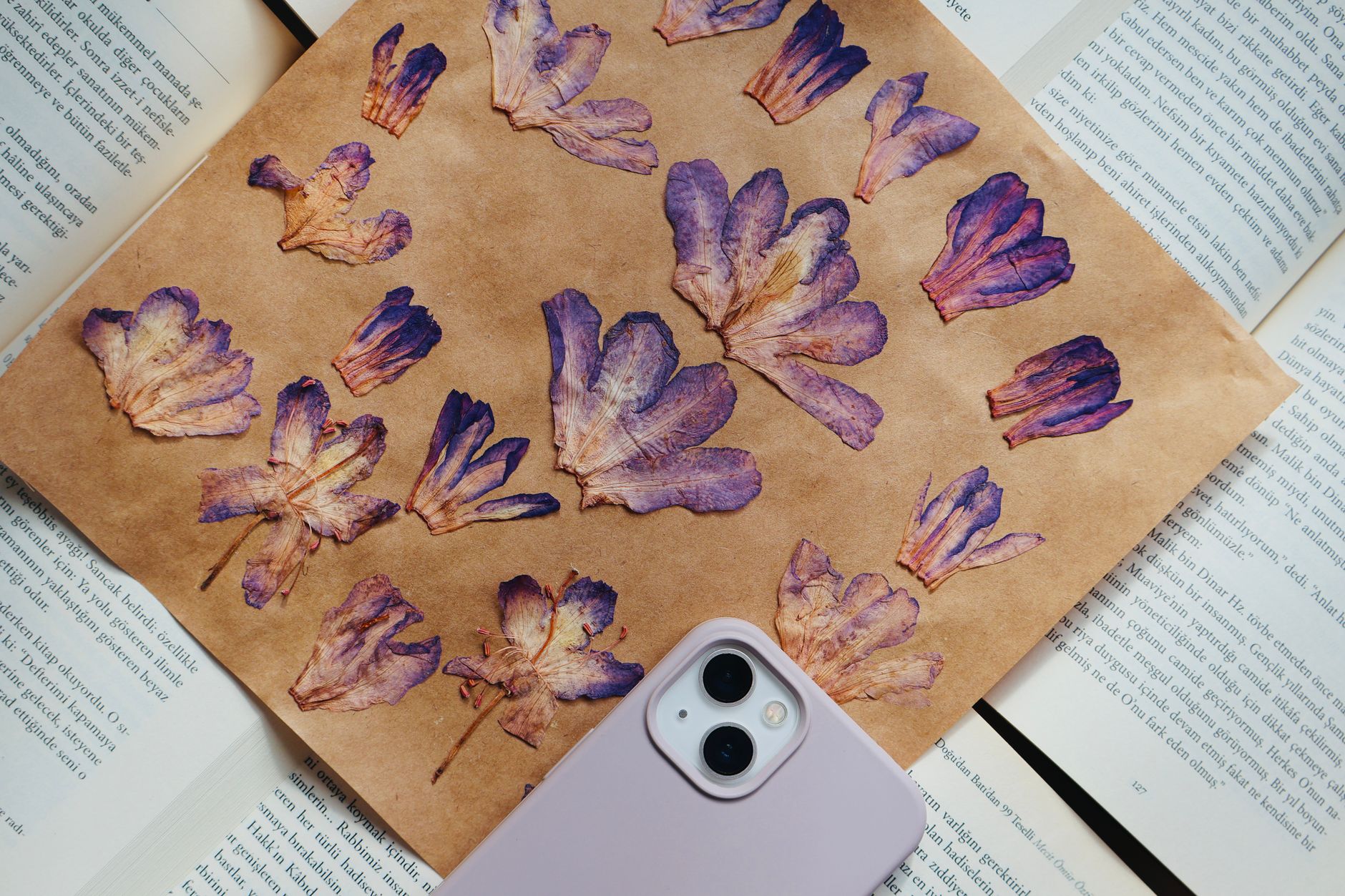
Pressed flowers are having a moment. They show up in resin art, in framed displays, on handmade cards, and in journals. The technique is simple: you flatten the flower between absorbent material under weight, and moisture wicks away over 1–3 weeks.
The book method:
- Choose flowers that are naturally flat or thin. (More on which ones below.)
- Place the flower between two sheets of parchment paper or wax paper.
- Slide the parchment sandwich into the middle of a heavy book — a dictionary, a textbook, a hardcover novel you are never going to read.
- Stack more heavy books on top. The more weight, the better.
- Wait 2–3 weeks. Resist checking. Every time you open it, you slow the process and risk tearing a petal.
Best flowers for pressing:
- Pansies and violas — flat faces, vivid colors, press perfectly
- Fern fronds — the quintessential pressed greenery. Elegant and easy.
- Daisies — the thin petals flatten cleanly. Remove the center if it is too bulky.
- Queen Anne’s lace — delicate, lacy, and stunning when pressed
- Violets — tiny and jewel-toned. Perfect for resin work.
- Cosmos — thin petals, beautiful translucency when pressed
- Individual rose petals — you cannot press a whole rose flat, but individual petals press beautifully and keep their color
Not great for pressing: anything thick, bulky, or three-dimensional. Roses (whole), peonies, chrysanthemums, orchids, and sunflower centers are all too dense. You can sometimes press them if you slice them in half first, but the results are unpredictable.
🧪 Silica Gel: The Secret Weapon
If you want to preserve a flower in its full three-dimensional shape with vivid color, silica gel is the method. It is the technique professionals use, and it produces results that genuinely look like the flower was frozen in time.
What it is: silica gel is a granular desiccant (the same stuff in those little “do not eat” packets). You can buy craft-grade silica gel at any art supply store, Michael’s, Blick, or online. A 5-pound container costs $15–$25 and is reusable indefinitely.
How to do it:
- Pour a 1-inch layer of silica gel into an airtight container (a plastic tub with a lid works perfectly).
- Place the flower face up on the gel. Gently arrange the petals how you want them.
- Slowly pour more gel around and over the flower, using a spoon to gently work granules between petals. The flower should be completely buried.
- Seal the container. Wait 3–7 days depending on the flower’s density.
- Gently pour off the gel and lift the flower out. Brush off residual granules with a soft paintbrush.
The result: a flower that looks almost fresh — full shape, vibrant color, papery-light texture. Roses, peonies, dahlias, ranunculus, and orchids all preserve spectacularly with this method.
Pro tip: spray the finished flower with a light coat of aerosol hairspray or craft sealant to protect it from humidity. This is especially important in the Bay Area, where ambient moisture can soften a silica-dried flower over time if it is left unprotected.
💎 Resin Casting
This is where preservation meets art. Embedding dried or pressed flowers in clear epoxy resin creates coasters, jewelry, paperweights, bookmarks, and decorative objects that last essentially forever.
The basics:
- Start with fully dried or pressed flowers. Fresh flowers contain moisture that creates bubbles and cloudiness in resin. Dry them first using any method above.
- Use a two-part epoxy resin designed for crafting (Art Resin, Alumilite, or similar). Mix according to the instructions.
- Pour a thin base layer into your mold, let it partially set, then place the flower face-down (for coasters) or face-up (for display pieces). Pour the remaining resin over the top.
- Pop air bubbles with a heat gun or lighter held briefly over the surface.
- Cure for 24–72 hours. Do not disturb.
The Bay Area has a thriving maker community with resin workshops. If you want to try it hands-on before committing to supplies, look for classes at craft studios in Oakland, the Mission, or Berkeley. It is an increasingly popular craft night activity.
🖼️ Shadow Boxes and Frames
A shadow box — a deep picture frame with a glass front — is the classic way to display preserved flowers. Wedding bouquets, memorial flowers, prom corsages, and birth-day arrangements are the most common candidates.
- Dry the flowers first using hang drying or silica gel.
- Arrange them inside the shadow box on a backing of your choice (linen, cardstock, velvet).
- Secure stems with hot glue or floral wire.
- Add a label, a card, a date, or a small note if you want context: “Our wedding bouquet — June 14, 2025.”
- Seal and hang. Keep out of direct sunlight to prevent fading.
For a simpler version: press individual flowers and frame them flat behind glass. A row of three pressed roses in matching frames on a wall is minimalist, beautiful, and takes about 20 minutes to assemble after the pressing is done.
🌺 Potpourri: Old-School and Still Charming
Potpourri fell out of fashion somewhere in the early 2000s and is quietly coming back. The premise is simple: dry the petals, add fragrance, and put them in a bowl.
- Pull petals from roses, lavender, and any fragrant flowers in your arrangement.
- Spread them on a baking sheet lined with parchment paper. Let them air-dry for 3–5 days in a dry spot, stirring occasionally.
- Once fully dry, place in a bowl and add a few drops of essential oil — lavender, rose, eucalyptus, or whatever scent you like. The dried petals absorb the oil and release fragrance slowly.
- Optional: add dried citrus slices, cinnamon sticks, star anise, or dried herbs for texture and scent complexity.
- Refresh with a few drops of oil every few weeks as the scent fades.
It is not a preservation method in the display sense, but it is a lovely way to get a second life from flowers that would otherwise go in the compost.
🌫️ The Bay Area Humidity Factor
One thing that sets flower preservation in the Bay Area apart from, say, Arizona or Colorado: moisture. The marine layer, the fog, the generally humid air along the coast and into the inland valleys all work against drying.
Here is how to adapt:
- Hang-drying takes longer here. Budget 3–4 weeks instead of 2. If it is July and Karl the Fog is parking on your roof every morning, it may take even longer.
- Use an interior closet, not the garage. Garages in the Bay Area absorb moisture from the concrete and the air. An interior closet with the door closed is consistently drier.
- A dehumidifier helps. If you are serious about drying flowers (or if you just want to protect a special arrangement), a small dehumidifier in the room speeds everything up.
- Silica gel is your best friend here. It works regardless of ambient humidity because the container is sealed. This is the most reliable method for our climate.
- Seal finished pieces. A coat of hairspray, clear sealant, or resin protects dried flowers from reabsorbing moisture. Unsealed dried flowers in a Bay Area home can soften and mold over time.
💐 Which Flowers from Your Arrangement to Save
When you receive a mixed arrangement from bayflorist.com, here is a quick guide to which stems are worth preserving and which are better off in the compost:
Worth keeping:
- Roses — hang-dry or silica gel. Always worth it.
- Eucalyptus — hang-dry. Keeps its scent and shape for months.
- Baby’s breath — hang-dry or use as-is (it dries in the vase).
- Lavender — hang-dry. Fragrance lasts a long time.
- Hydrangea heads — hang-dry when they start feeling papery.
- Statice, strawflower, globe amaranth — born to be dried.
Skip these:
- Tulips, lilies, daffodils, iris — too much moisture, too little structure
- Alstroemeria — the petals thin and curl unevenly
- Gerbera daisies — the large heads collapse when dried
- Carnations — technically dryable but aesthetically disappointing
The best approach: pull the keepers early (while the arrangement is still looking good) and let the rest finish their run in the vase. You do not have to preserve the whole bouquet — three dried roses from a meaningful arrangement, framed or placed in a small vase, are enough to hold the memory.
🌿 Start with Something Worth Keeping
The best preserved flowers start as the best fresh flowers. Browse our seasonal arrangements, plants, and gifts. We deliver across the Bay Area same-day — and now you know exactly what to do with them when the week is over. 🌿