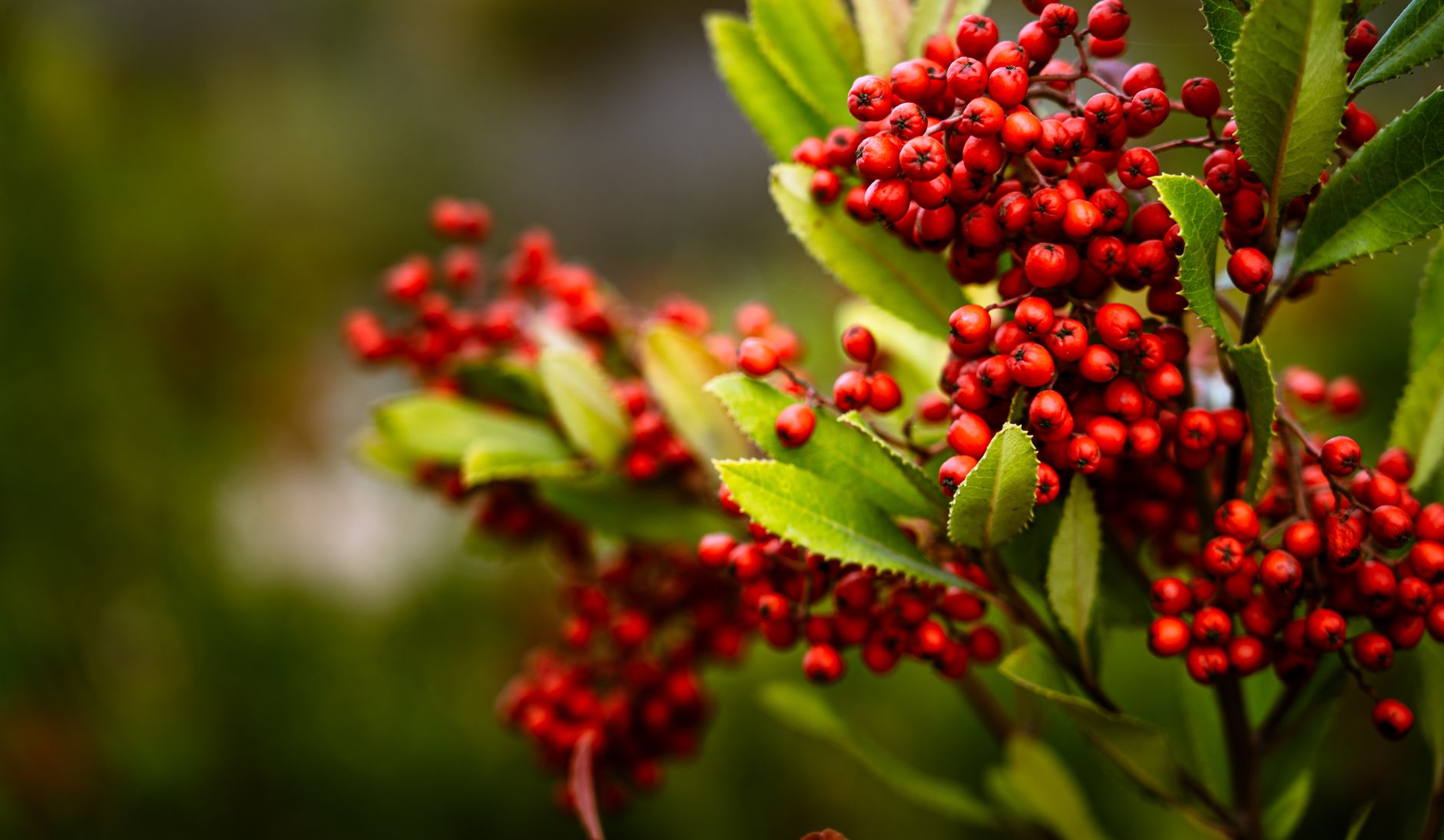
Around the middle of December, the hills around the Bay turn up a plant that looks like it was designed for the holidays: a dark green, toothed-leaf shrub loaded with clusters of bright red berries. It is toyon (Heteromeles arbutifolia), also called Christmas berry and California holly, and it is native here. This holiday season 2026, if you want greens and berries that actually belong to the Bay Area, this is the plant to know, along with a few of its neighbors.
🍂 What Toyon Is
Toyon is an evergreen shrub or small tree, usually 7 to 16 feet tall, with sharply toothed leaves 2 to 4 inches long. It blooms in early summer with small white flowers (the peak is June), and the berries develop in late summer and mature in December, which is why it has been tied to Christmas for so long. It is native to California, extreme southwest Oregon and Baja California, and it is a prominent part of coastal sage scrub, chaparral and oak woodland. In the garden it prefers well-drained soil, sun or partial shade, and once established it is drought tolerant.
The berries are a winter pantry for wildlife. California quail, mockingbirds, band-tailed pigeons, American robins, cedar waxwings, hermit thrushes and raccoons all eat them. If you have toyon in your yard, you will know exactly when the birds find it.
🎬 The Hollywood Story, Sorted Out
You will hear that Hollywood is named for toyon, the “California holly.” It is a nice story, but the name came from somewhere else. Daeida Wilcox, who donated land to help develop the neighborhood, learned the name from an acquaintance who owned an estate called Hollywood in Illinois. Toyon was named the official native plant of the City of Los Angeles in 2012, so the connection is not completely made up, just not the origin of the name.
⚖️ A Law From 1921
Toyon has had to be protected from its own popularity. In 1921, collecting branches for Christmas had become so popular in Los Angeles that California passed a law forbidding the picking of plants on public land, or on any land you do not own, without the landowner’s written permission (Penal Code section 384a). That is why we say the same thing every year: do not cut toyon from hillsides, parks or open space. Use branches from your own yard, buy from a grower or florist, or take a photograph and leave it where it stands.
⚠️ What About Eating It?
Toyon berries are acidic and astringent and contain a small amount of cyanogenic glycosides, which break down into hydrocyanic acid on digestion; mild cooking removes it. Native Californians traditionally ate the berries cooked and made them into jelly and cider. That is a tradition, not a florist’s recommendation. In arrangements, treat the berries as decoration and keep them out of reach of small children and pets, which is our own standard advice for any berried holiday greenery.
🍃 California Bay Laurel: Fragrant, With a Warning
California bay laurel (Umbellularia californica) is a large evergreen tree native to California coastal forests and the Sierra foothills. Its leaves are smooth-edged and lance-shaped, 1¼ to 6 inches long, and when they are bruised they smell pungent and camphor-like because of a compound called umbellulone. It is also known as pepperwood and the “headache tree,” and the name earns itself if you inhale too much of it. In a wreath or a garland the scent is strong and clean, and a few sprigs go a long way.
The warning: do not use California bay in the kitchen as if it were the familiar bay leaf. California bay leaves contain large amounts of umbellulone, which is toxic, and it is absent from the culinary bay (Laurus nobilis) you buy in a jar. The two trees are easy to confuse. Use the California tree for decoration only.
The species also has a few local landmarks. The oldest known living laurel is the Jepson Laurel in San Mateo County, on San Francisco Water Department land, and there is another laurel more than 300 years old in Bay Tree Park in San Mateo.
🧶 Silk Tassel: A Late-Winter Surprise
Coast silk tassel (Garrya elliptica) is an evergreen shrub of California’s coastal ranges with glossy, wavy-edged leaves. It blooms in late winter and early spring, and the male plants are the showy ones, with gray-green catkins that hang down up to 12 inches long. The dried bracts stay on the plant into summer as pale gray decorations. If you see long tassels in a January garden, this is probably what you are looking at.
🎄 Using Native Greens in Arrangements
- Toyon sprigs in a vase. Cut a fresh angle on the stems, put them in clean water and keep the vase cool. The leaves are tough, and the berries hold their color for a good while indoors.
- Pair with white or cream flowers. Red berries and dark green leaves are already a full palette. White roses, ranunculus or paperwhites keep it elegant. Our shared guide to holiday flowers and greens covers the potted plants and the pet-safety question for each.
- Bay laurel for scent. A few sprigs in a wreath or tucked into a table garland add fragrance without needing an extra flower.
- Leave some for the birds. If you have a toyon in your garden, take a few sprigs and leave the rest. The fruit is a major winter food source.
📍 Where This Fits in the Bay Area Season
December in the Bay Area is not a snow-and-evergreen season, and that is the point of native greens: they show off the region’s own winter rather than imitating somewhere else’s. If you want a reason to get outside before the holidays, our guide to the Golden Gate Park flower trail is a good walk, and our post on the city’s official flower, the dahlia, explains what is still going at the end of the season. Hosting for Thanksgiving? Our order-by guide for hosts and guests has the timing.
📋 The Short Version
- Toyon is the native red-berried shrub known as Christmas berry. The berries mature in December.
- Hollywood’s name came from an Illinois estate, not from toyon.
- California law, since 1921, bars picking plants on land you do not own without the owner’s written permission. Use your own yard, or buy it.
- California bay laurel smells great in a wreath, but it is not the bay leaf you cook with.
- Keep berries out of reach of pets and small children, and leave some for the birds.